
Not all granite is the same. Walk into any stone yard in Metro Atlanta, and you will find slabs at wildly different price points, yet the labels rarely tell the full story. Granite countertop grades are among the most misunderstood factors in the countertop buying process, and choosing without understanding the differences can mean paying a premium for a slab that chips within a few years, or missing out on a mid-grade stone that would have outlasted anything in the showroom.
Quick Takeaways
- How granite countertop grades are determined
- What the differences between low, mid, and high-grade granite mean for durability and appearance
- Why price alone does not reflect the quality of granite countertops
- How to make a confident choice for your kitchen or bathroom remodel
How Are Granite Countertop Grades Determined?
There is no set, industry-wide standard for grading granite. The grades are set in-house, so each time you visit a supplier, you could be looking at a somewhat different grading system. There are some commonalities, though, which can be quite helpful when making the best selection. Granite is generally graded by how many soft minerals are present, as well as by its color and cut. Rarer colors are given a higher grade, and granite that has fewer soft minerals will also receive a higher rating.
The cost of the granite is not always a good indicator of its quality. Granite that is imported or especially rare can be quite expensive, yet it might not be of the greatest quality. You will also need to keep the supplier in mind. High-grade granite at a discount store may be roughly equal in quality to lower-grade granite at a high-end retailer. Since grading varies from location to location, you cannot make blanket assumptions.
This is why working with an experienced local fabricator matters. A knowledgeable team can help you evaluate slabs on their actual merits, not just their label. If you are exploring material options beyond granite, our guide on granite vs. quartz countertops breaks down how these two popular choices compare.
What Do the Different Granite Grades Mean for Your Home?
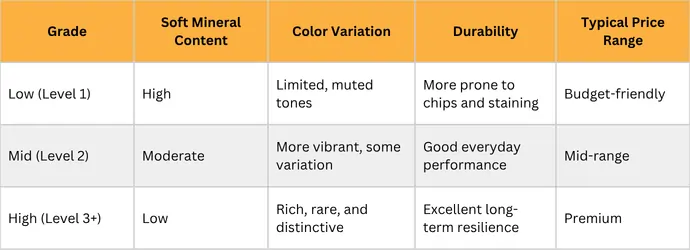
The biggest difference in durability lies between low-grade and high-grade granite. Low-grade slabs contain significantly more soft minerals, making the material more likely to chip, ding, or discolor over time. High-grade granite contains fewer soft minerals, so you can count on it to be more resilient and to withstand daily wear and tear much better.
The other major difference is coloring. Low-grade slabs tend to have little color variation, and the tones are not always particularly vibrant or clear. With mid-grade granite, you will find more vivid coloring, though variety is still somewhat limited. High-grade materials can include green or red tones, which tend to be both durable and rare.
Regardless of grade, all granite needs regular care to stay looking its best. See our notes on how to clean granite countertops for maintenance tips.
Granite Grade Comparison
Use this summary to quickly compare what each granite countertop grade typically offers:
Why Does the Quality of Granite Countertops Matter Beyond Grade?
Grade is just one piece of the puzzle. The quality of granite countertops is also shaped by the thickness of the slab, the precision of the fabrication, and the expertise of the installation team. A Level 1 slab installed by skilled professionals will often outlast a premium slab that was poorly cut or set. When evaluating your options, always ask about fabrication standards and not just the stone’s grade level.
Frequently Asked Questions
Yes. Any well-installed granite countertop is viewed by buyers as a premium upgrade, and a mid- or low-grade slab fabricated by an experienced team can hold its value just as reliably as a high-grade slab. What matters most for resale is that the stone looks clean, fits the kitchen well, and shows no obvious chips or seams.
Quality granite feels dense and solid, shows consistent patterning without large filler patches, and resists scratching. Viewing the slab in natural light reveals color depth and clarity. Working with a reputable fabricator that lets you inspect full slabs rather than small samples is the most reliable way to evaluate quality.
Ready to Upgrade Your Countertops?
Legacy Countertops has guided Metro Atlanta homeowners through this decision since 2010. Here is what the grades actually mean and how to use that knowledge to get the best value for your home.
Choosing the right granite countertop grade does not have to be overwhelming. The team at Legacy Countertops has helped homeowners navigate stone selection, fabrication, and installation for over 16 years. Whether you are drawn to a classic Level 1 slab or a rare high-grade exotic, we can help you find the perfect fit for your space and budget.
Request your free custom quote or call us today. We serve all of Metro Atlanta, GA.